Validation#
Stark et al. 2025 recently compared existing exposure time calculators for HWO (AYO, EXOSIMS, and EBS). We followed the same validation process with pyEDITH, confirming a general agreement between our code and the others.
As part of the pyEDITH testing pipeline, we reproduced the validation scenarios compared in Stark et al. 2025 and found a reasonable agreement.
Since pyEDITH stems from AYO, we expect to find the smallest differences between AYO and pyEDITH. This is not always the case: we noticed some minor differences in the calculation of the zero-point flux between IDL and Python, which are caused by intrinsic differences in the interpolation algorithm. These differences caused all of the variables dependent on the zero-point flux (the stellar leakage, the exozodi, the noisefloor count rates, as well as the exposure time) to be different up to 10%, which also appeared in the general ETC comparison performed by Stark et al. 2025.
We also notice some differences in the calculation of some coronagraph-related variables (\(I\_star\), \(omega\_core\)): pyEDITH relies on the Python-based external package yippy for the calculation of these variables, which is marginally different from the original AYO calculation.
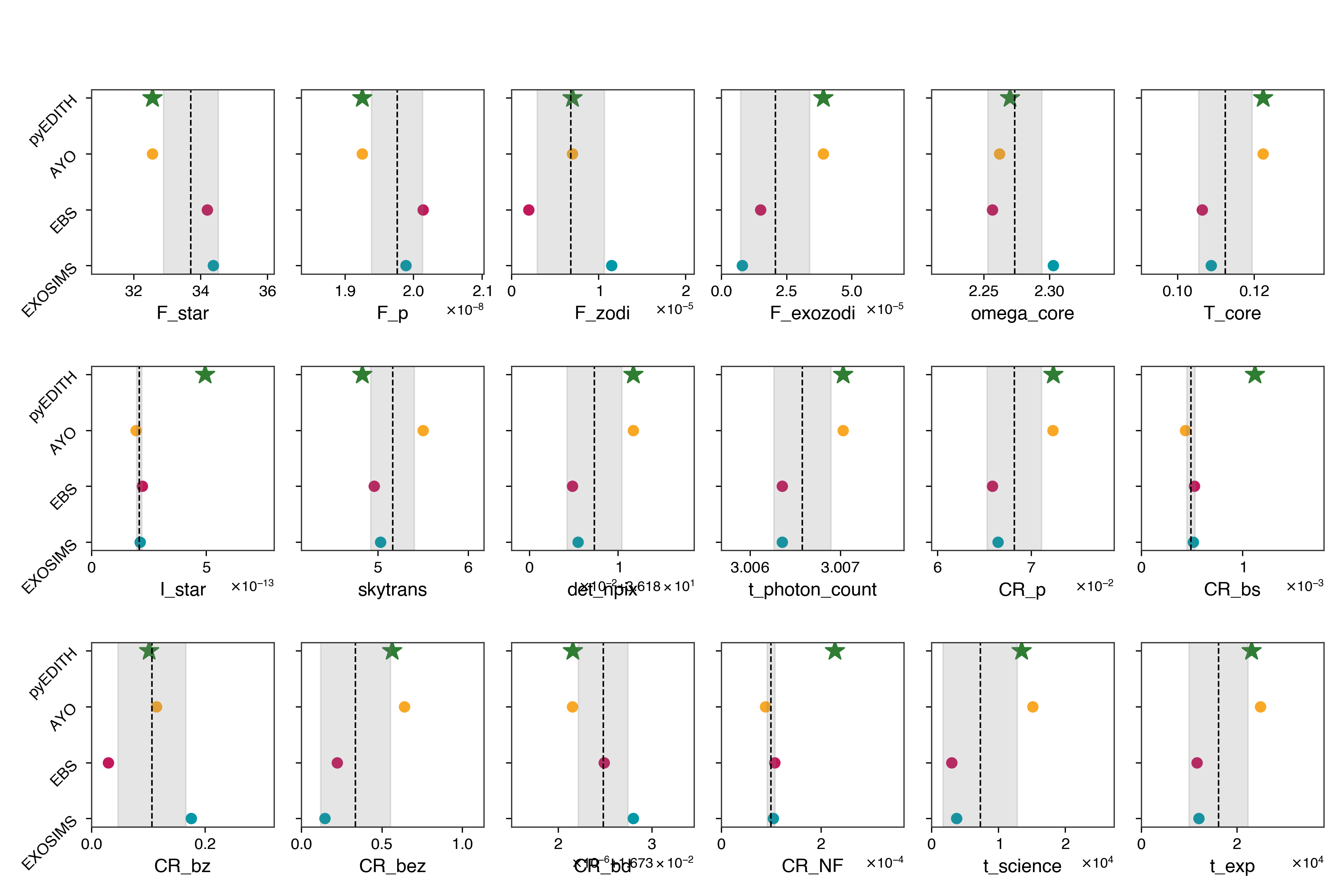
In the figures below, we show the results for the three earlier ETCs compared to pyEDITH, for all the cases explored in Stark et al. 2025. Markers show: results from \texttt{pyEDITH} (green stars); AYO (yellow circles); EBS (red circles); EXOSIMS (cyan circles). As a dashed black line, the mean value $\mu$ of the estimates obtained by AYO, EBS, and pyEDITH; as a shaded gray area, the 1-\(\sigma\) envelope of these estimates.
HIP 26779 at 500 nm
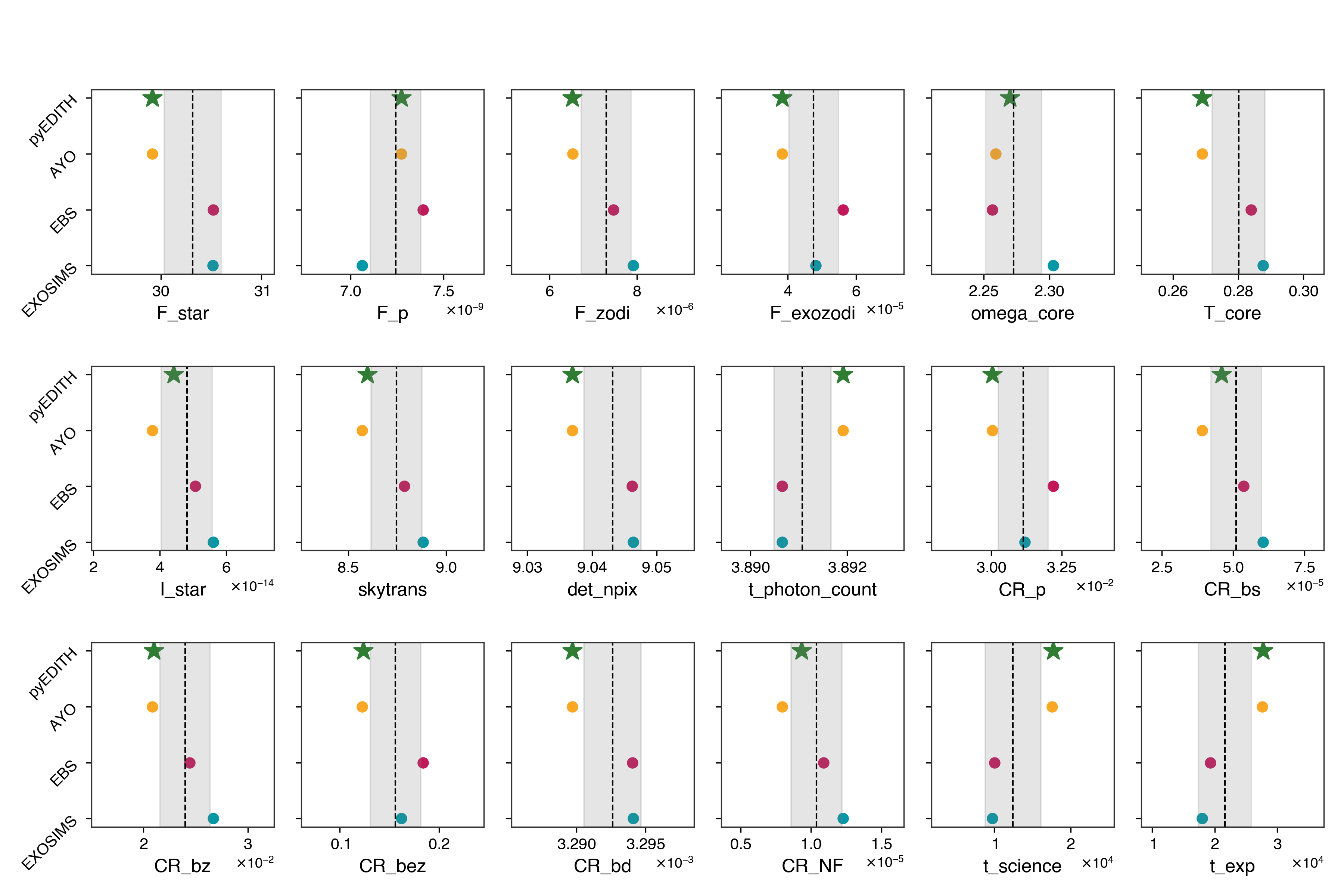
HIP 26779 at 1000 nm
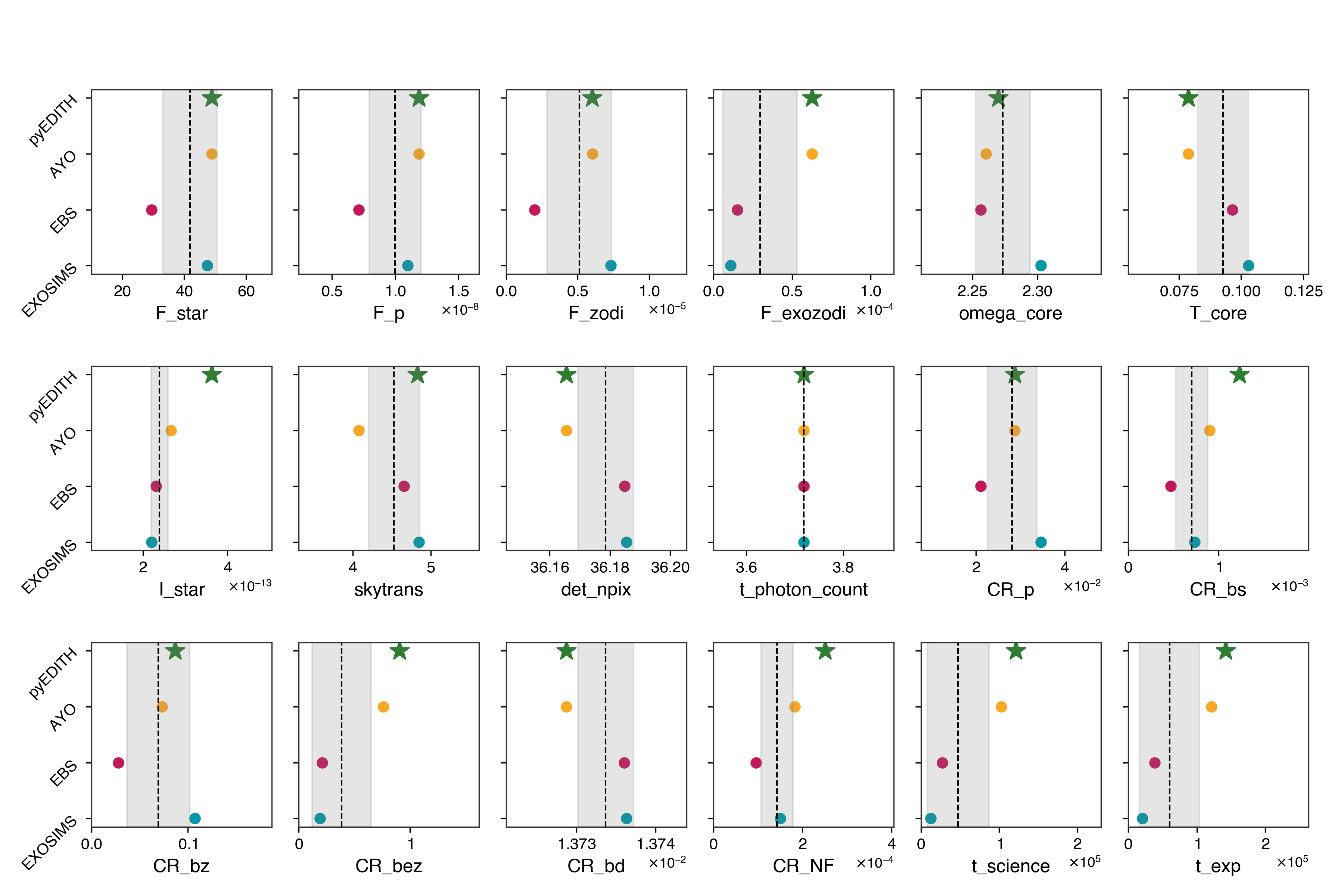
HIP 32439 at 500 nm
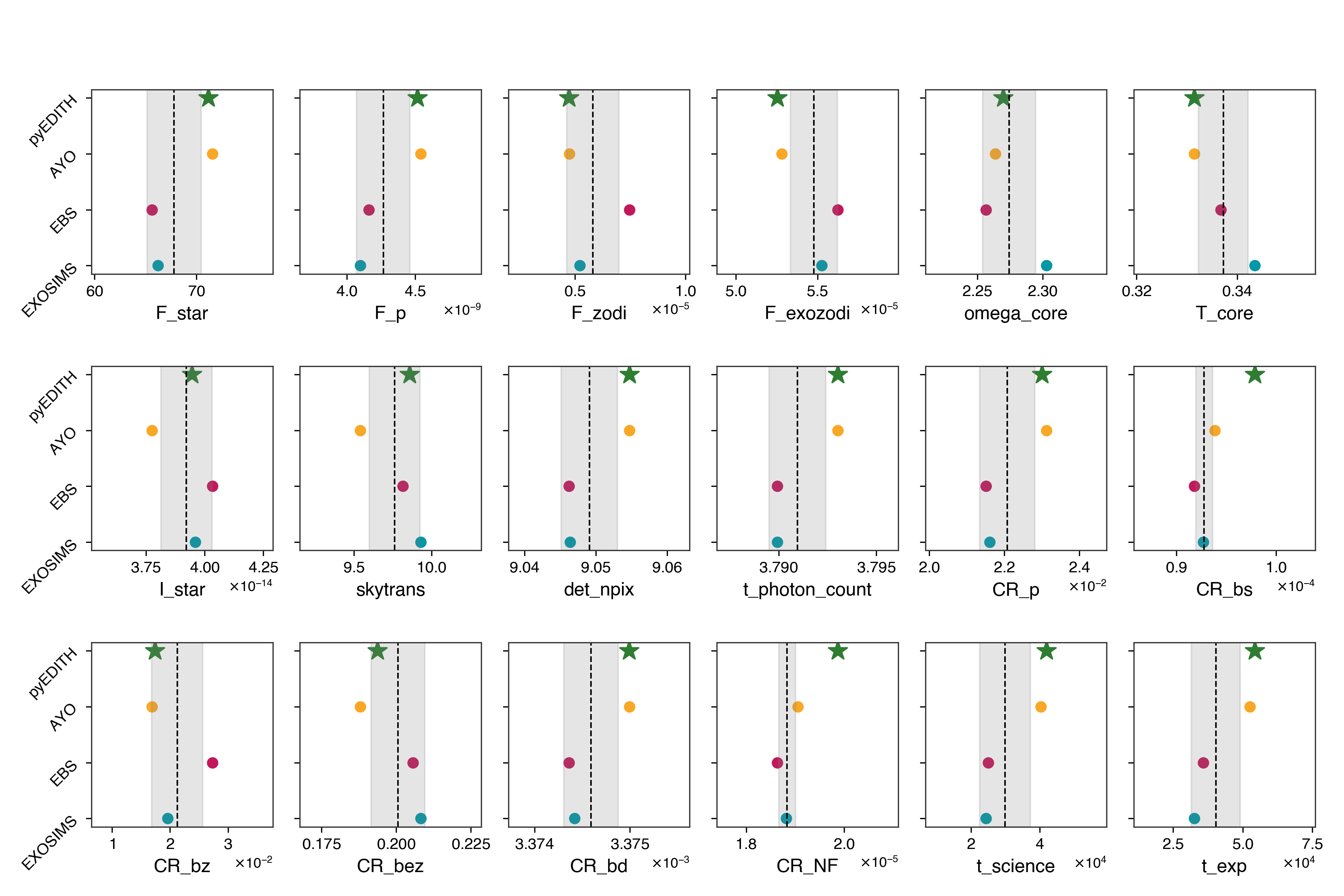
HIP 32439 at 1000 nm
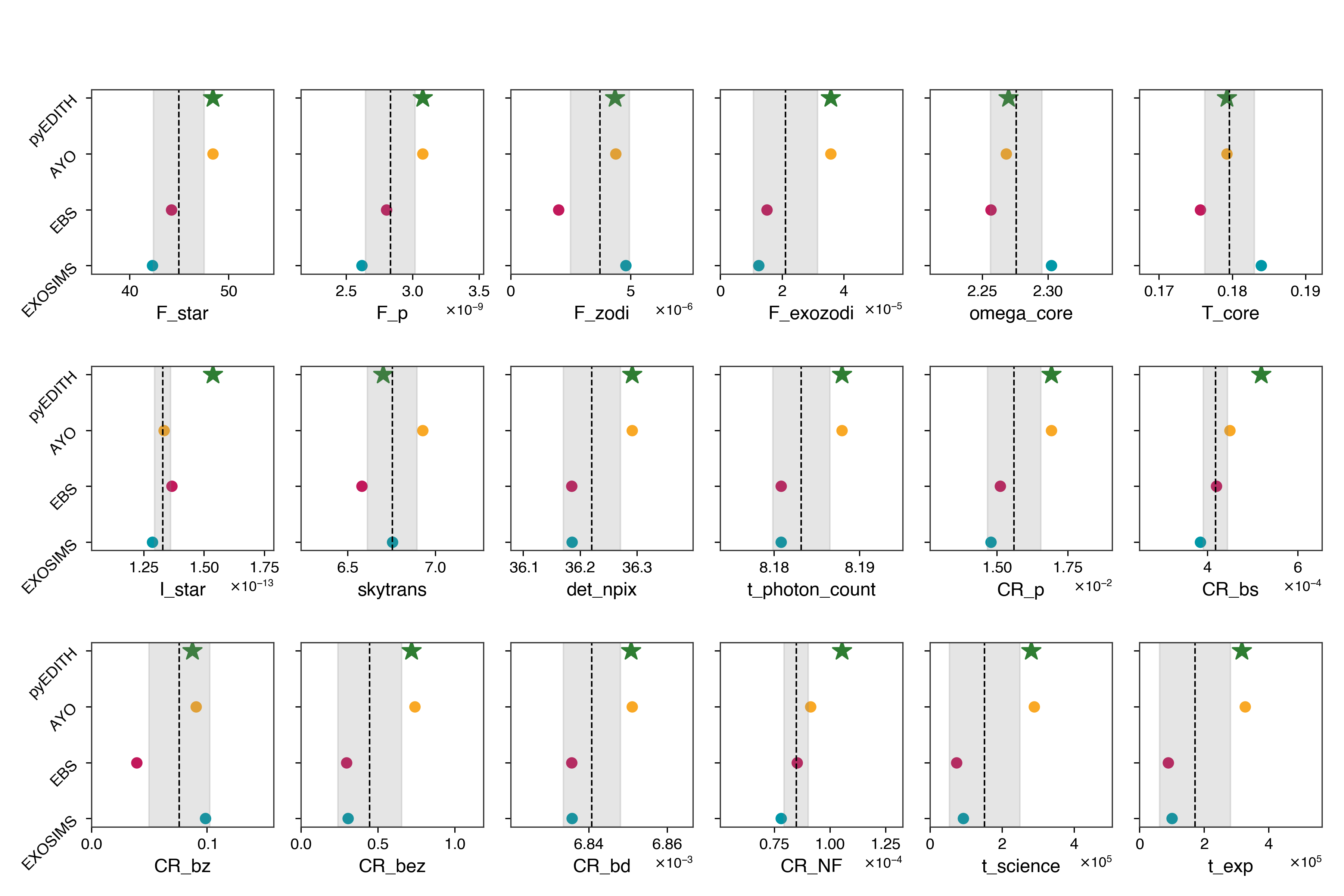
HIP 77052 at 500 nm
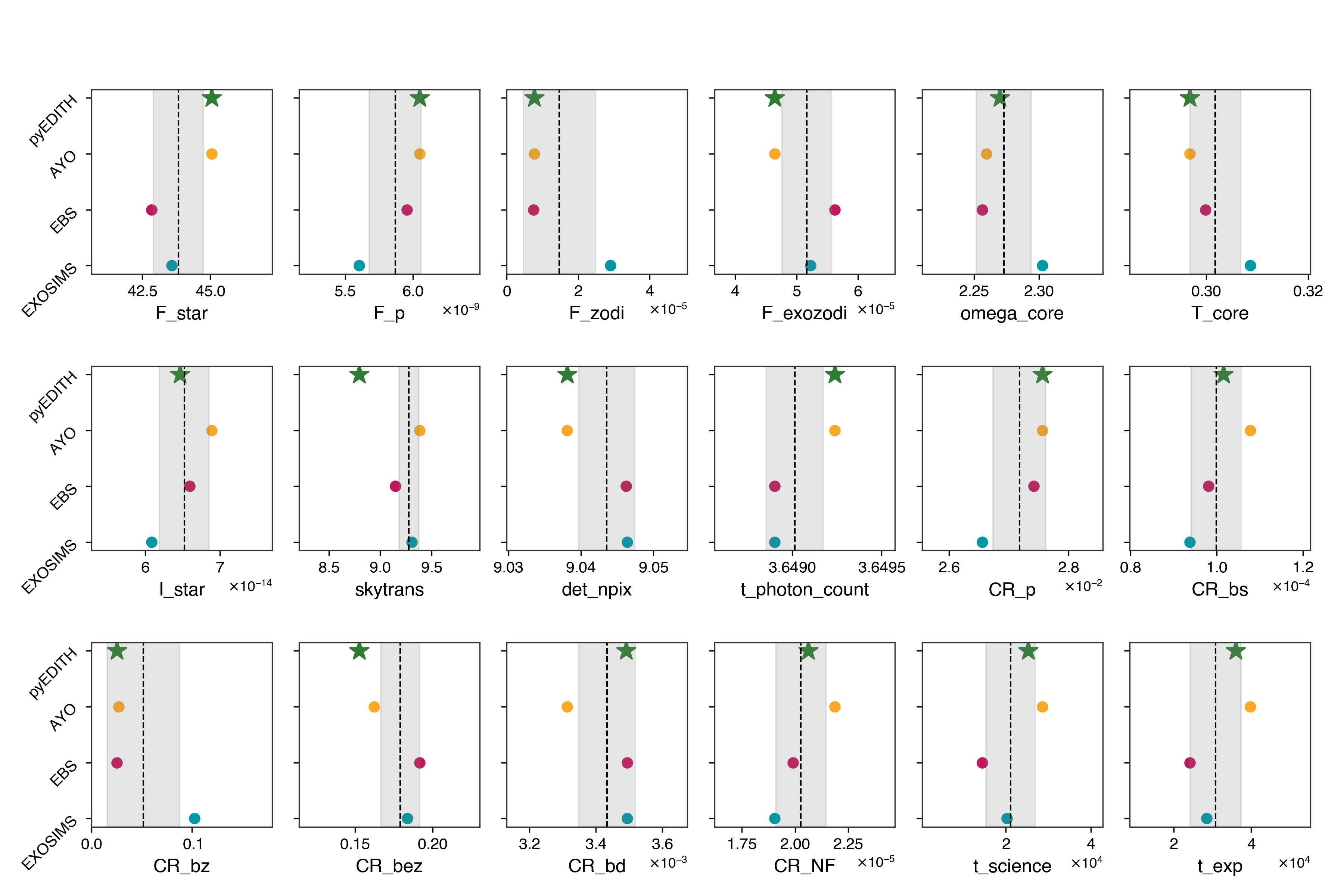
HIP 770272 at 1000 nm
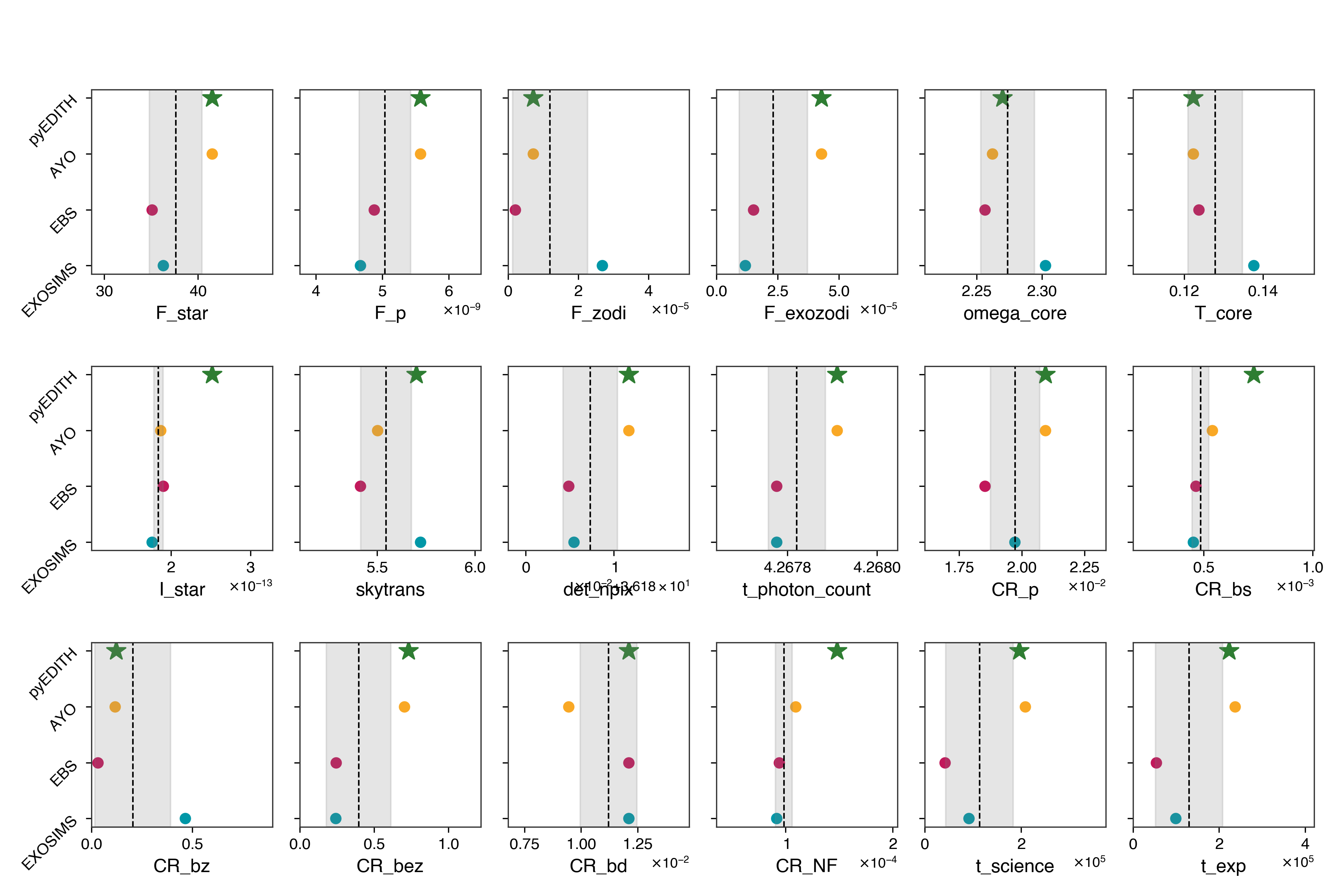
HIP 113283 at 500 nm
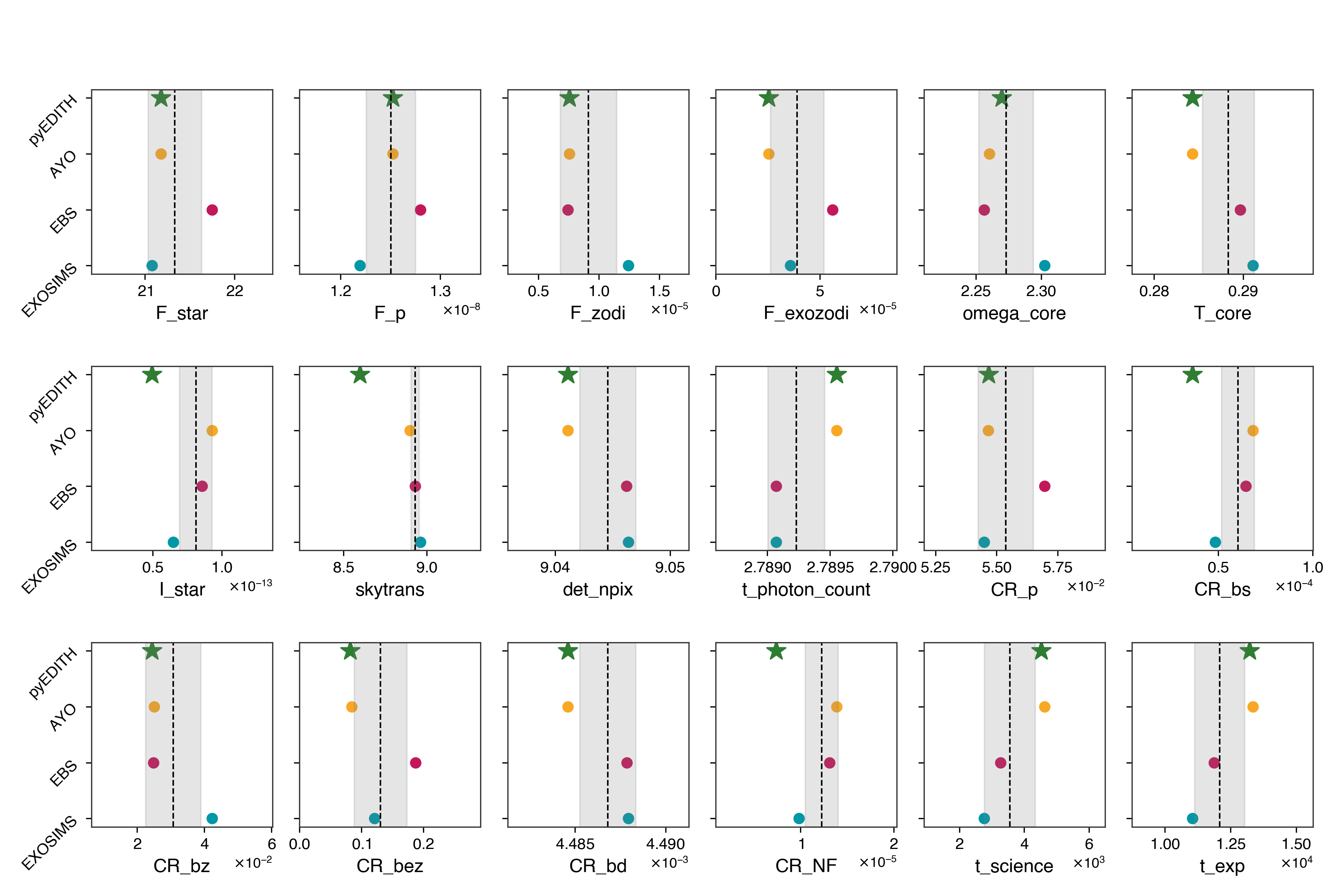
HIP 113283 at 1000 nm